New location

Come on over to my new site: www.endurancenerd.com


Going to be posting regularly there.

Showing posts with label seven cycles. Show all posts

Thursday, September 20, 2012

Seven Cycles 622 SLX

You know what they say about pictures, so these should be worth a few hundred thousand words at least.....


Tuesday, June 7, 2011

Earthquake proof bikes!

Remember in mid February when that 6.3 magnitude earthquake hit Christchurch, NZ?  This was before all the volcanoes started erupting, before all the tornadoes hit the US, before the tsunami and resulting nuclear crisis in Japan.....it seems like the year ought to be older.  This is merely an interesting story about 2 bicycles who survived the quake. 

About 3 years ago, I collaborated with Seven Cycles to build steel road bikes for a very nice couple from Grand Junction, who had retired and planned to spend a lot of time traveling and riding their bikes.  Because of the travel we built them with S&S couplers, which, if you're not familiar, allow the bike frames to be broken down into two pieces and packed into an airline approved hardcase -- your bike is well protected and you don't get charged bike fees on the plane, which can run $100 per leg.


As with all the custom bikes I build, not only was the frame geometry full customized for their riding style and purpose, but the fork was rake-matched for optimal handling as well (eat your heart out twitchy stock bikes).

They rode these bikes all over and if the bikes had passports, the stamps in them would rival any globetrotter's.  Paris, London, Sydney, all over the US..........you get the idea.  I think in two years the bikes had been ridden about 12,000 miles and had flown upwards of 45,000 miles.

Spring of 2010, they came back and again told me how much they loved their bikes, but....

But, they wanted to be able to run bigger tires to handle some moderate off-road, muddy, gritty trails as well as be a little more forgiving on the rough cobbles common throughout Paris.


This time they opted for titanium bikes with S&S coupler (and custom paint to boot) that could fit up to 35mm tires.  No compromises on function, of course, so we went outside to Waterford to build custom steel forks with the proper rake (in this case 58 mm) that fit the fatter tires and still had an appropriate axle to crown measurement to keep the head tube at the angle it was designed for.


The bikes were finished, and almost immediately whisked off to Paris to see the 2010 Tour.  These bikes, like their steel siblings, traveled far and wide until late January 2011.  


They were taken to New Zealand to tackle the Otago Trail.  Two weeks of every trail and road condition imaginable and they had safely and successfully completed their mission.  The bikes were cleaned as best as possible, and carefully packed away into their travel cases.  They soon found their way to the concierge's locked storage at the Crowne Plaza Hotel in downtown Christchurch, while the owners continued site-seeing on foot the remainder of the trip.

On that late day in February the earthquake hit.  My clients were in the lobby of the hotel, saying it felt like being in an elevator that suddenly drops, except that instead of dropping down, everything lurched sideways.

Like nearly everyone in that part of New Zealand, they fled to a safe area -- in this case a nearby park -- and took up residency with tarps and sheets of plywood supplied by the Kiwi government.  

Everything was left at the hotel.  Everything.  Bikes, computers, cameras, clothes, GPS's, passports.  With the help of the US Embassy and local government, they were able to finally make their way back to Colorado.

The Crowne Plaza Hotel, luckily is one of the most well built structures in Christchurch, and it didn't sustain major damage in the quake.  However, buildings immediately surrounding it sustained serious structural damage and, like many buildings in the area had either collapsed or were threatening to, so nobody was even allowed in the area in the weeks following.

Without much information, aside from checking Google Earth images to check which buildings were still standing, they had no idea when or if they could expect to get their things back, but being the compassionate, pragmatic people that they are they always reinforced that they felt very lucky that the only thing they may have lost were things, while many others their lost much more.

Finally......

Nearly three months later, I received an email that they thought the bikes were on the way -- something had been sent from the hotel -- and they might be somewhere between Hong Kong and Cincinnati (?!??).

Well, they did show up:


It was clear that someone had opened up the hardcases on their way back into the US, and let's just say that they were not closed and re-packed with the utmost of care.
Both bikes were brought into the Studio, and aside from having to true all four wheels, replace some cables and housing and generally clean them up, they were in surprisingly good shape.


Besides a few scrapes and chips in the paint, the frames were perfect, but that wasn't too surprising:  titanium frames, properly built can last about 200 years or so (steel is about 50 years, aluminum about 15 or so, and carbon is around 10 years).
So, things turned out okay, and the bikes live to travel on.  I'm glad these rolling works of art and their owners, are able to roll around the world together for many years to come.


Monday, July 19, 2010

New Zipp carbon clincher 404 -- Updated review

July 25, 2010

You can read below the original post, but for those who have been there already, here is my second take:

I still really am impressed with the wheels. One new thing I noticed was the sound -- or lack there of.  Previous versions of the 404 carried the standard whooosh-whoosh sound, especially when you stood up.  I guess it was the echo through the carbon of the road.  This was much more prominent in the 808 and nearly symphonic in their disc.  On the new Firecrest rim it is nearly gone.  I honestly don't know why or if it is a good or a bad thing....just something that I (finally) realized.

I rode them in the wind and rain this past Wednesday morning (we had a very rare rainy morning here in the desert).  I still found them to handle very well in cross-winds, and the wet-braking was very good.  I think most of that can be attributed to the Swiss Stop pads, but I thought it was nonetheless important that braking never got grabby in the wet. 

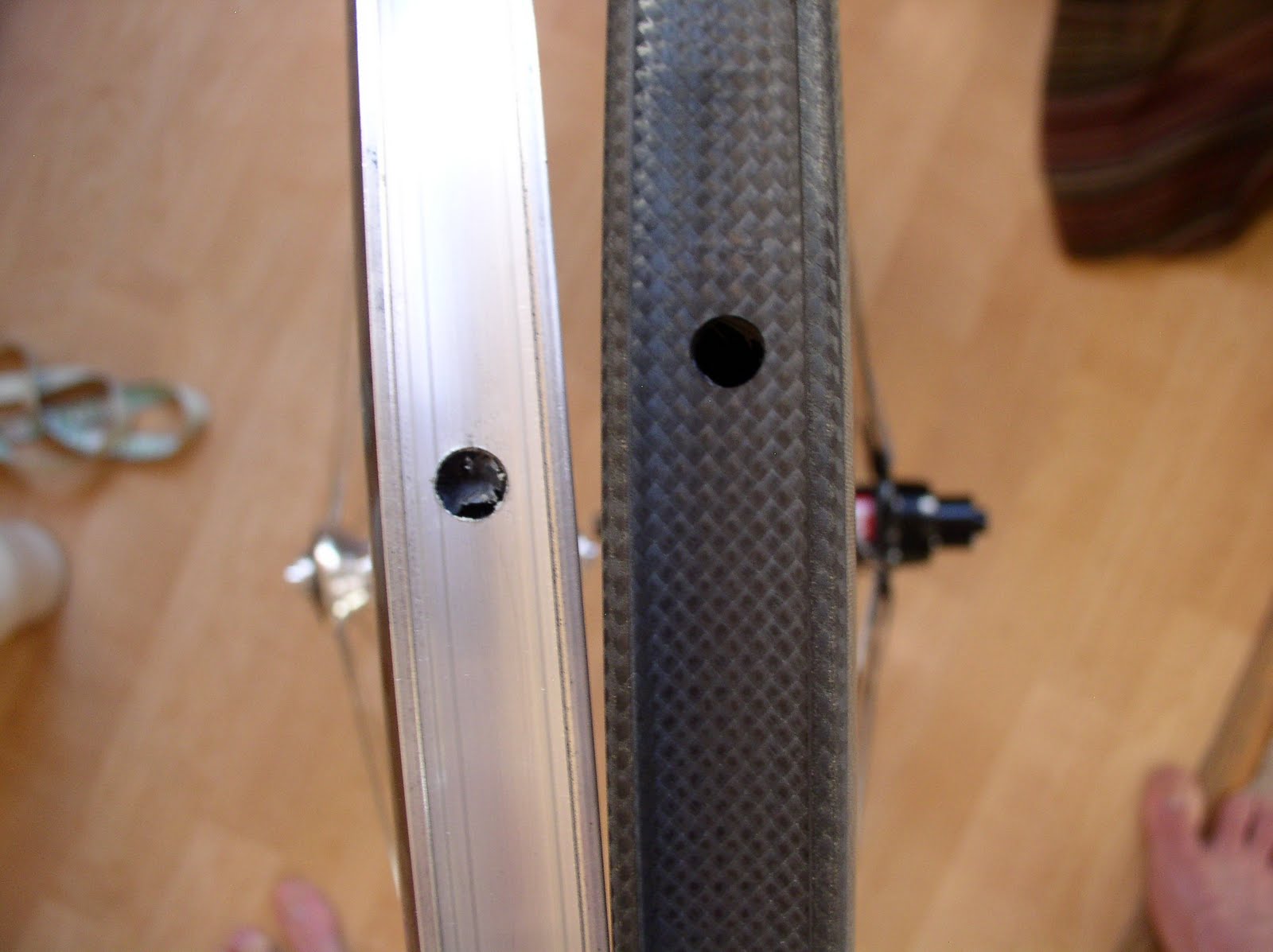
My one knock so far on the wheels is something I knew before I rode them -- the spoke holes are drilled not molded in the layup process.  Zipp has been doing this for years, and I here that he tool that accomplishes this very difficult procedure is actually quite remarkable, but in recent years an improvement has occurred elsewhere in the wheel market.  At Edge Composites, they have a technique of molding in the spoke holes, and they use a nipples that has a dome top section (the part that fastens to the inside of the rim) that allows the spoke to rotate ever so slightly, if needed to relieve stress.  My wheel-builder tells me that the Edge wheels he has built all come out nearly flawless and with great tension.  When I heard that Zipp was redesigning the 404 I hoped that hey would find away around the drilling (and prevent the small bend that sometimes occurs in their nipples), but I must say that my wheels have always been so strong it rarely, if ever presented a problem.

That's it for now -- I will update more as I go.

So I'll just get it out of the way and say, I am super lucky to be able to try these wheels.  As far as I know they are not shipping them yet, so I know this is pretty sweet to be able to try them early.

Zipp has waited for years to do a full carbon clincher, because they weren't confident that the technology was there.  Many of the early versions from other manufacturers had some issues with durability so succeeding iterations tended to be heavy and overbuilt.  I remember talking to Zipp engineer Josh Poertner, a few years ago and his basic take on it was "If we can't do it well (strong and light), then we just won't do it yet."  (Loosely quoted).

I have been a fan of Zipp products for a number of years, and I've been fortunate to be able to try many different flavors.  I was lucky enough to be able to ride a set of custom laced 303s in the Leadville 100 about 8 or 9 years ago, and I always have a couple sets of 404s in the garage.

So, to the new rim:

First, let me say that these rims I received are different from what will be shipped -- they are 28-hole, and given the strength and durability of these I expect that they will ship with spoke counts of something like 16/18 front and 20/24 rear.  My wheels are overbuilt, for sure, but I don't mind that so much.

What is glaringly obvious with rims in hand for the first time is the radically different shape from the older 404.  They are wider at the spoke bed, wide in the "belly" of the rim, and wider at the brake track.  The design is their Firecrest rim design, and it is different.  At first look, I thought that these could be ridden on a mountain bike, and might take a 29er tire quite well (Disclaimer: Zipp does not recommend you ride their wheels on mountain bikes or with disc brakes, under any circumstances).

One small bonus is that the tires mounted up easier than on previous 404 iterations.  Granted it wasn't overly difficult before to get a tire on but I would occasionally need to use one tire lever at the very end to get it to set.  Not so with these.  My Zipp Tangente (21mm) tires went on by hand -- not so loose that it concerned me, but I was able to work at it and get the tires on and off by hand.  Kind of nice in case of flats later on.

So I just mounted everything up and went on the first ride.  The Zipps certainly changed the look of my Seven Axiom SL:

So In know what you're thinking -- new Zipps and a frame pump?  Hey call me old school but I hate getting caught out with a dead CO2.  And those small pocket size pumps make me feel like JoJo the Circus Monkey as I pump them 8,000 times just to hit 95 psi.

I rode the wheels up here:


The picture is at the top of Little Park Road, which is a twelve mile climb just out of town here.  It has some 14% grades but a lot of it in the 5-8% range.  Pretty tough for someone in my sorry shape.  I knew how the Zipps would climb -- that was not what I was curious about.  I wanted to make sure they handled well downhill, see how they tracked on the flats, and what a cross-wind felt with them.

Downhill they were.....disconcerting.  I mean that in a good way.  I descended the east side of the Monument (Colorado National Monument) and they are so much faster than the Fulcrum "training wheels" I had on the bike I was not prepared for the speed when I entered the first few corners.  Eventually I got the hang of it and found the wheels corner very predictably.  They almost feel like a really good set of skis on perfect snow -- when you set that outside edge they just rail right through.  The braking was predictable and not grabby as it can sometimes be on a carbon brake surface -- I also replaced my SRAM brake pads with Swiss Stop yellow pads for these wheels.

I think the area I was most pleased with is how the wheels act in a cross wind.  On previous deep wheels I have ridden (the old 404s among them) I always felt like I was getting pushed around just a little bit in a cross wind.  I don't know the mechanics of why these wheels did not, but I didn't get one inkling of this sensation when I rode them.  I kept bracing when I felt a strong gust come at me from the side, but it never did push me.  This is one area I will report back more on later.

So far I am really impressed.  I am sure I will find something I want to change in them, but nothing so far.  Stay tuned

-J


Monday, March 29, 2010

The wife's bike

So any healthy relationship has to have balance. The past few years my wife has been in the enviable position of getting to ride a different demo bike every year, and sometimes having a choice of multiple bikes.

The downside is that in this situation, you don't get a perfectly fit bike most of the time (unless you're lucky, like me, and most size 54/55s are usually pretty darn close. She does have some shoulder problems, however, and that usually causes her to sacrifice her low back in order to maintain a comfortable reach to the bars. Suffice it to say that she tends to leverage a bit more through one side of her lumbar spine, especially when she climbs.

So, finally this year, I decided to surprise her for her birthday with designs for a custom bike "all for her." I decided on Seven's Axiom SL (double butted titanium), which is their workhorse model, a SRAM Force group, FSA K-Wing carbon compact bars, Selle Italia Lady Gel Flow saddle, and I had a pair of Zipp 404 rims lying around that I had Mike at Bigwheels (www.lacemine29.com) lace to some DT Swiss 240s hubs.

I don't have a great creative streak in me so I gave the Seven designers some themes to work with: Ethiopia (our kids are adopted from there), gourmet cooking (my wife, who is a Nurse Practitioner, loves to cook enormous meals on the weekends to the delight of our friends. The painters at Seven cam up with the scheme you see below:

there is an outline of the country of Ethiopia on the top tube, and there are two "Electric Blueberry" panels on the seat and down tubes that have a fleur de lis pattern on them. the fleur de lis has many meanings and references, but it is also the cover for Julia Childs' Mastering the Art of French Cooking.

I think they did well:


Wednesday, February 24, 2010

Seven Elium SLX

So this is one of the prettiest custom builds I have ever done. I won't ruin this with too many words. I'll just explain the build:

Elium SLX frame and fork (this is a titanium and carbon mix - everything white is Ti except the fork)
Integrated Seatpost
Campagnolo Record 11 group (oh good God!)
DT Swiss wheelset
3T ergoNova Team bars
Custom Celtic Cross decal

BTW the Integrated seatpost has two seperate bolts to adjust tilt and fore-aft independently of each other -- which is phenomenally convenient -- and when you see the parts machine out of Ti, I can't help but think that there is no way that they make money on that part of the build.

Enjoy.


Monday, November 23, 2009

the ultimate tool

I have never been a car guy. I never got into tools or working on cars (primarily because cars were and are nearly impossible to do any work on anymore, but oh well). Now, however, I really enjoy working on bikes. When you see a lot of clients, like I do, especially in the intense one-on-one nature of a bike fit, you are "on" a lot. It's like being an educator -- some days I talk all day long; or at least it feels that way. I love when I can steal away and quietly work on client's bikes -- it is pretty therapeutic.

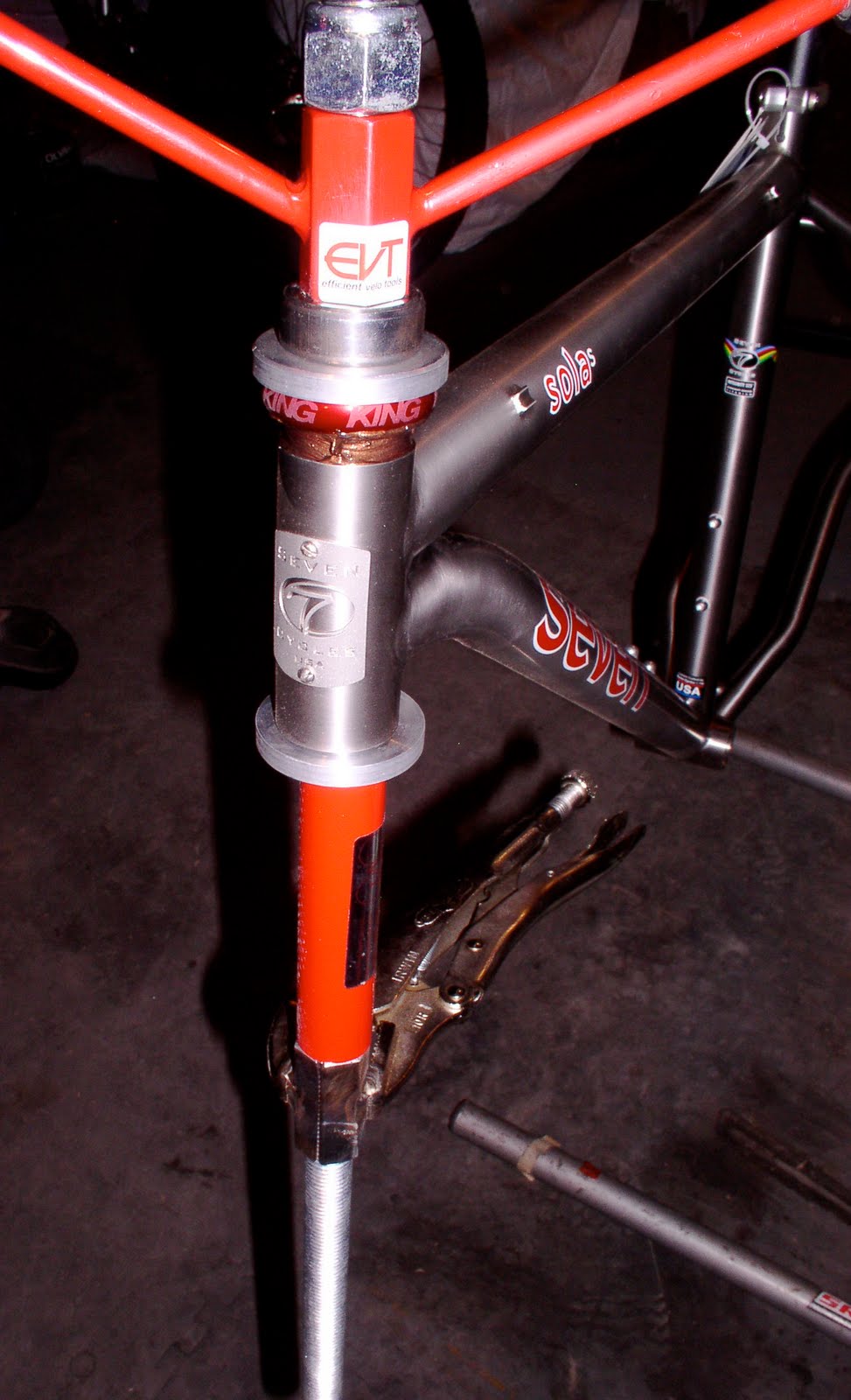
So now I love really nice tools, and MC turned me onto Efficient Velo Tools, which is like a Toys'R'Us for geek bike mechanics like myself. I ordered the Smoothie Headset Press because it is the only one I've found that can press the sometimes long head tubes I build in the custom market.

The tool works like a dream, thanks in part to being able to get leverage at the bottom and top of the press (see the vise grip clamp at the bottom in the pics below), and a nice bearing underneath the "wingnut", which keeps the pressing action extra smooth.

The headset is my old standard -- a Chris King one and an eigth, in red with the stealthy Sotto Voce decals.

The bike is a Seven Sola S (full Ti)single speed 29er with slider dropouts (i'll post more on this bike when it's done).


the headset


the frame


The tool


cups on press


ready for action


finished

Tuesday, July 7, 2009

The Womens Specific Myth

I get asked a lot from my female clients that come to me for a fitting before they buy a bike (which is the right way to do it -- get a professional sizing done first, THEN buy a new bike and complete the fitting process on it) wondering which "womens specific" bike they should get.

First let me say that, certainly there are many ladies out there that are quite comfortable on their womens specific bike; and they can work out great. But in general, the idea that women need different geometry is a myth.

Let's start by looking at it from an industry standpoint. What are the major bike manufacturers doing? They seem to go one of two ways:

1. They take the men's line of bikes, eliminating the sizes over 57cm, stick narrow handlebars, 170mm cranks, a softer seat, and accent the paint with pink or purple.

A good example of this is Cannondale:


Compare the "like-sized" bikes and you'll find no difference whatsoever in their geometry; same effective top tube, head tube, angles, standover, etc. They use narrower handlebars, presumably a shorter stem or straighter (non-setback) seatpost because they tout a shorter cockpit length, and shorter cranks. (Also girlie colors.)

2. Others do all of the above and then shorten the top tube (and possibly lengthen the head tube).

The truth is that some women do well with option number 1 and others do well with option number 2 .......


........but so do most men.


Taking the 2nd option, where they actually change the length of a few tubes on the bike, assumes that relative to their height women have shorter torsos and/or shorter arms (and possibly less flexibility). While many women do have shorter torsos (and therefore are long legged) their numbers do not outnumber their more proportionate or long-torsoed breathren in great enough numbers to warrant a change in all their bike geometry, I think. Even if you accept that long-legged, short-torsoed women represent the center of the bell curve and have that large of a representation, then changes that the bike companies make to design a "woman's" bike are often not different enough to accommodate the women who actually need it -- on the order of a 1 - 2 centimeter shorter top tube and possibly 1 - 1.5 cm longer on the head tube.

Incidentally, this is the approach that Specialized, Look, Cervelo, among many others take when designing a "higher handlebar position bike" or one they tout to be used in Paris-Roubaix. These are designed for men and women. So it's good that they make these changes, but often I don't think they are completely filling the market niches -- which is why when I build so many custom bikes for people who don't fit these niches.

So I know, now it sounds like that first I was complaining that they make the changes at all and then I complain that they need to make even greater changes. But that's what I think they should do....

.....but they should do the same thing for the men's bikes as well. They should have two or three *grades* of sizing from more aggressive to more relaxed.

Some companies are doing this to a small degree, but, again, usually the changes don't go far enough. Or the more relaxed geometries available are built like Bradley Fighting Vehicles and don't come in a performance package at all. I don't think it's wrong for people to want to ride their bikes hard and have nice components and wheels WHILE being comfortable. Our cycling population is getting older, but a lot of these riders still want to compete or at least continue doing big rides.

So I'm okay with companies NOT changing the geometry specifically for their women's bikes. I'm also okay with them changing the geometry -- it just doesn't need to be "womens specific." Even riders with Y chromosomes need geometry adjustment to optimize their fit.

As long as the stock bike manufacturers continue to err on the side of producing bike geometry with a racing-inspired pedigree, this will continue to be an issue. Unfortunately many cyclists will be sold a bike that does not match their riding strengths, simply because it is all that is available.

Custom bike manufacturers (like Seven Cycles) should continue to benefit from this oversight, especially as the cost of a stock bike and a custom bike continue to get closer and closer together. (Take a look at Seven's Gateway Program and then look at some of the cost of Specialized's Tarmac line, Trek's Madone, Cannondale's SuperSix -- many of those stock bikes get up close to $10,000 in their higher iterations!)

So when anyone (man or woman) is looking for a new bike, find out first what size bike you need and if any special considerations to the geometry of the bike ought to be made. There may be a stock option out there for you. If you think your current bike and fit are pretty good take a look at the setup -- if you have a threaded stem that is set to the "Minimum Insert" line or your stem is short length and/or high rise, then you might be in need of some additional adaptations to your bike geometry.

Why not just have the high rise or short stem on there (or the saddle slid all the way forward or backward on the rails for that matter)?

The problem with making these changes is that the handling of the bike is not built around these set-ups. These changes can work to make the bike fit better and be more comfortable, but they can also begin to affect the handling and the balance of the bike.

It's bad enough that the big stock manufacturers make forks with only 1 or 2 offsets and rakes to use on all their bikes -- from their 62cm down to their 49cm bikes.

(SIDE NOTE: Very small bikes and very big bikes should have forks with different offsets, but this costs money, so there are very limited options in forks out there and the big bike companies try to make up the difference with the head angles of the bikes. When doing this, one end of the spectrum -- either the big or the small -- will have compromised handling. Some of the companies, when listing the geometry for different sizes will even list some of the fork offsets and not list the others, saying they are "proprietary". Having used the Zin to log in the geometry and setup of my client's bikes -- which gives you fork rake and trail among many other measurements -- I can tell you that many times the rake of the fork is not different from the other listed sizes, the manufacturer just chooses to hide the fact that it is the same fork.)

So then when we change the handlebar height or seat fore-aft significantly on these bikes the handling and safety can sometimes suffer.

So do some research, go see a professional bike fitter that can help you find what will work best for you, and if you plan to spend more than $3000, don't discount a custom bike if it suits your needs better than the stock offerings.

Ride well.