New location

Come on over to my new site: www.endurancenerd.com


Going to be posting regularly there.

Wednesday, August 11, 2010

The Saddle Library

I consider my business to be a a healthy mix of high end, boutique bike sales, with no nonsense, a lot of bang-for-your-buck services.  I don't expect my clients to be wasteful in how they spend money with me.

A few years ago, when I first began using the infrared motion capture system from Retul, I had 2 clients in quick succession who were having significant saddle problems, and their journey to solving this problem followed fairly similar paths.  They both did what most people do, and went to their local bike shop and explained that they were having saddle sores/discomfort and were promptly sold a seat that had proved to be very popular with the shop (for whatever reason).  Seat went on the bike; seat was ridden.  Discomfort persisted. 

They then asked a friend, who recommended another seat -- ordered it online; seat went on the bike.  Discomfort persisted.  They repeated this at a second and sometimes a third bike shop.  They now had a collection of four or five saddles a piece and had spent between $400-$500.

They didn't know each other, but they both came to see me for a bike fitting at the recommendation of a mutual friend within a month of each other, and their fittings went very similar.  We had left whatever saddle was on there last for the fitting.  We made many adjustments (as usual) to the seat, but also to cleats, bar position and even gave them exercises/stretches to help with imbalances when needed.

The result?

This last saddle felt great. 

So, fantastic, they had found the saddle that worked for them.  As an experiment, I asked them to bring in their "saddle collection" on a few follow ups.  I traded out for one saddle and then another and after a week of riding on each in their new position, lo and behold!  they all worked pretty well (except for one of them).  So really, for the most part, it wasn't the saddle, but the position of the saddle.

I thought this was a pretty cool experiment.  Neither client was terribly happy that they had spent hundreds on redundant seats, but they were quite thrilled to finally be comfortable riding their bike long distances again.

So after this experience, I found it ridiculous that there was nowhere that you could test out a new set for a few days at a time without plunking down the cheese to buy it.  So I began collecting saddles that were popular with other clients, and pretty soon I had quite a collection.  Here are some pictures of just a portion of them:


Now I have saddles from:

WTB
Selle Italia
Fizik
Selle SMP
Terry
Salsa
Selle Royal
Hobson
Profile

And I'm going to be adding soon a few from Prologo, San Marco, and possibly Brooks.

The idea behind my new collection -- or saddle library -- is that clients can "check out" a saddle for a week or two, and actually ride it to see if it's compatible for them, rather than just taking someones word for it.  When we find that right saddle and we have it in the right position, then they buy.  Hopefully, no more wasting a few hundred bucks on saddles that aren't a good fit.

Monday, July 19, 2010

New Zipp carbon clincher 404 -- Updated review

July 25, 2010

You can read below the original post, but for those who have been there already, here is my second take:

I still really am impressed with the wheels. One new thing I noticed was the sound -- or lack there of.  Previous versions of the 404 carried the standard whooosh-whoosh sound, especially when you stood up.  I guess it was the echo through the carbon of the road.  This was much more prominent in the 808 and nearly symphonic in their disc.  On the new Firecrest rim it is nearly gone.  I honestly don't know why or if it is a good or a bad thing....just something that I (finally) realized.

I rode them in the wind and rain this past Wednesday morning (we had a very rare rainy morning here in the desert).  I still found them to handle very well in cross-winds, and the wet-braking was very good.  I think most of that can be attributed to the Swiss Stop pads, but I thought it was nonetheless important that braking never got grabby in the wet. 

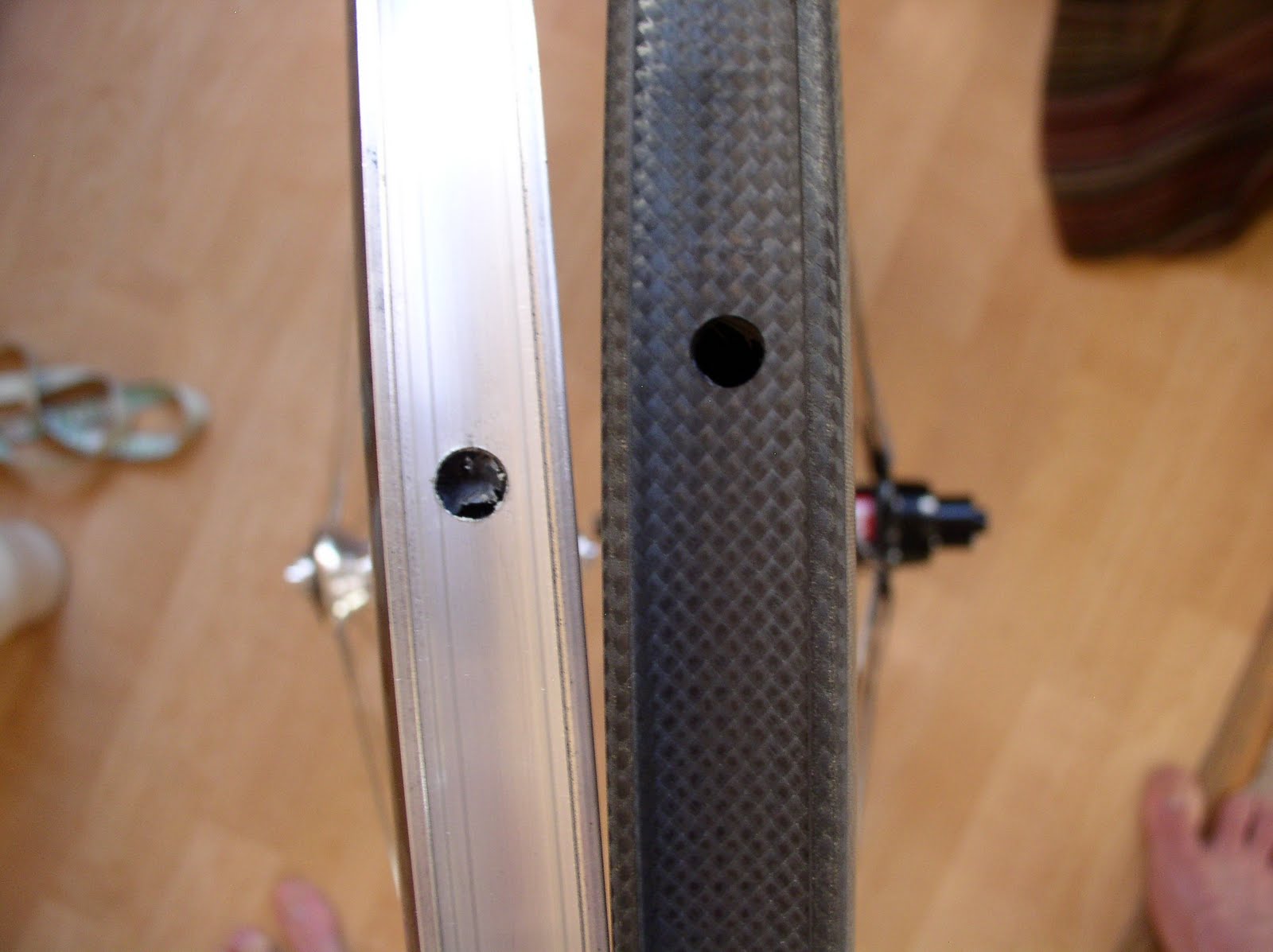
My one knock so far on the wheels is something I knew before I rode them -- the spoke holes are drilled not molded in the layup process.  Zipp has been doing this for years, and I here that he tool that accomplishes this very difficult procedure is actually quite remarkable, but in recent years an improvement has occurred elsewhere in the wheel market.  At Edge Composites, they have a technique of molding in the spoke holes, and they use a nipples that has a dome top section (the part that fastens to the inside of the rim) that allows the spoke to rotate ever so slightly, if needed to relieve stress.  My wheel-builder tells me that the Edge wheels he has built all come out nearly flawless and with great tension.  When I heard that Zipp was redesigning the 404 I hoped that hey would find away around the drilling (and prevent the small bend that sometimes occurs in their nipples), but I must say that my wheels have always been so strong it rarely, if ever presented a problem.

That's it for now -- I will update more as I go.

So I'll just get it out of the way and say, I am super lucky to be able to try these wheels.  As far as I know they are not shipping them yet, so I know this is pretty sweet to be able to try them early.

Zipp has waited for years to do a full carbon clincher, because they weren't confident that the technology was there.  Many of the early versions from other manufacturers had some issues with durability so succeeding iterations tended to be heavy and overbuilt.  I remember talking to Zipp engineer Josh Poertner, a few years ago and his basic take on it was "If we can't do it well (strong and light), then we just won't do it yet."  (Loosely quoted).

I have been a fan of Zipp products for a number of years, and I've been fortunate to be able to try many different flavors.  I was lucky enough to be able to ride a set of custom laced 303s in the Leadville 100 about 8 or 9 years ago, and I always have a couple sets of 404s in the garage.

So, to the new rim:

First, let me say that these rims I received are different from what will be shipped -- they are 28-hole, and given the strength and durability of these I expect that they will ship with spoke counts of something like 16/18 front and 20/24 rear.  My wheels are overbuilt, for sure, but I don't mind that so much.

What is glaringly obvious with rims in hand for the first time is the radically different shape from the older 404.  They are wider at the spoke bed, wide in the "belly" of the rim, and wider at the brake track.  The design is their Firecrest rim design, and it is different.  At first look, I thought that these could be ridden on a mountain bike, and might take a 29er tire quite well (Disclaimer: Zipp does not recommend you ride their wheels on mountain bikes or with disc brakes, under any circumstances).

One small bonus is that the tires mounted up easier than on previous 404 iterations.  Granted it wasn't overly difficult before to get a tire on but I would occasionally need to use one tire lever at the very end to get it to set.  Not so with these.  My Zipp Tangente (21mm) tires went on by hand -- not so loose that it concerned me, but I was able to work at it and get the tires on and off by hand.  Kind of nice in case of flats later on.

So I just mounted everything up and went on the first ride.  The Zipps certainly changed the look of my Seven Axiom SL:

So In know what you're thinking -- new Zipps and a frame pump?  Hey call me old school but I hate getting caught out with a dead CO2.  And those small pocket size pumps make me feel like JoJo the Circus Monkey as I pump them 8,000 times just to hit 95 psi.

I rode the wheels up here:


The picture is at the top of Little Park Road, which is a twelve mile climb just out of town here.  It has some 14% grades but a lot of it in the 5-8% range.  Pretty tough for someone in my sorry shape.  I knew how the Zipps would climb -- that was not what I was curious about.  I wanted to make sure they handled well downhill, see how they tracked on the flats, and what a cross-wind felt with them.

Downhill they were.....disconcerting.  I mean that in a good way.  I descended the east side of the Monument (Colorado National Monument) and they are so much faster than the Fulcrum "training wheels" I had on the bike I was not prepared for the speed when I entered the first few corners.  Eventually I got the hang of it and found the wheels corner very predictably.  They almost feel like a really good set of skis on perfect snow -- when you set that outside edge they just rail right through.  The braking was predictable and not grabby as it can sometimes be on a carbon brake surface -- I also replaced my SRAM brake pads with Swiss Stop yellow pads for these wheels.

I think the area I was most pleased with is how the wheels act in a cross wind.  On previous deep wheels I have ridden (the old 404s among them) I always felt like I was getting pushed around just a little bit in a cross wind.  I don't know the mechanics of why these wheels did not, but I didn't get one inkling of this sensation when I rode them.  I kept bracing when I felt a strong gust come at me from the side, but it never did push me.  This is one area I will report back more on later.

So far I am really impressed.  I am sure I will find something I want to change in them, but nothing so far.  Stay tuned

-J


Thursday, July 1, 2010

Reader email question

Got this question this week from a reader in Norway, and while it's not the most common, his back problem is more common than people realize:

I have spondylolisthesis grade 3. Bike fitting will be critical as a wrongly fitted bike is very painful.

What are the adjustments I would most likely need on a bike that is basically fitted right for a healthy back?
What are the typical “spondy adjustments”?

I (am) cycling quite a lot today on a hybrid that is 20 inches. I am 172 cm. The bike is maybe too big but it seems my back is better when I am streched forward.
I prefer a lying forward position (racing style) and the large bike size allows the seat to be adjusted forward compared to the pedals. Seat being slightly too low.

But I also want to do off road cycling. Problem is that the off roaders are smaller and more upright. (But there is no point in adjusting the off roader to give me a racing position)

I will be very happy to have some ideas about this from you.

Kind regards


GM

For those unfamiliar, a spondylolisthesis (not to be confused with spondylosis or spondylolysis -- professors in medical and PT schools love to torture first years with the differences between them) is when one vertebral body begins to slip forward relative to the one below it.  This slipping forward closes off the space for the spinal cord (within the spinal column/vertebrae) as well as for the nerve roots as they exit the spinal column.  Occasionally people even have a "step deformity" where if you run your fingers down the spine you can feel a "step" or a larger bump, which is the now more prominent vertebral body below.

These are tricky and early detection routinely is misdiagnosed as some sort of disk injury.  The treatments for disk injury and spondylolisthesis, however, are nearly opposite, so distinguishing is important.

In general, lumbar flexion helps to reduce the slipping vertebra, or puts it in a neutral position -- often clients can feel the bone "click" back into alignment very softly.  Lumbar extension, or back bending has the effect of pushing the bone further forward and causing more pain.

These people often get severe symptoms if they sleep on their stomach or have to stand in one place too long. 

You'll notice that our friend from Norway is more comfortable in a racing or stretched out position, and he's not alone.  My clients with spondylolisthesis often are more comfortable stretched out on their road racing bike, and really can't tolerate their mountain bike due to it's upright position.  The upright mountain bike position, like standing in one place, requires active abdominal stabilization in order to keep some "flexion pressure" on the lumbar spine -- or really just to keep the spine in neutral.  When we stand in place, our trunk muscles get lazy and we begin to "rest" on the static (non-muscular) structures of the spine, like the spinal ligaments, and more often than not our balance point pushes us into lumbar extension.  A very similar thing happens when we are in an upright position on our bike.  The stretched out racing position actually removes the need for active muscular stabilization because it aligns the vertebrae in flexion.

So what to do?

The obvious correction would be to set up a mountain bike in close to the same aggressive position that you find on a road bike, but few people want to have this position on their mountain bike because in the wrong terrain it can make it much more likely that you will catapult over the handlebars. 

The better fix is a careful positioning of the seat.  The tilt of the seat, is the biggest issue.  You actually want to err on the side of having the seat level or even tilted slightly up.  In order to keep pressure off the perineum (your softer bits) this forces you to rotate your pelvis posteriorly slightly which in turn creates some lumbar flexion, or at least a neutral lumbar spine.  The overall reach of the bike should be such that a bit of lumbar flexion can be created without getting too far forward with your position (resulting in the aforementioned trip over the bars), and shouldn't cause your shoulder blades to protract significantly in order to reach the handlebars (you don't want a rounded upper back posture).

This seat positioning is the most important factor, however a very good way to ensure that you have less trouble with your spondylolisthesis is aggressive strengthening of the abdominal muscles.  The abdominals are responsible for keeping the spine in a neutral position and preventing that lumbar extension.

So, thank you, for the great question, and please don't hesitate with more.

Stay tuned, as I am fortunate to have gotten my hands on a set of Zipp full carbon 404 clinchers.  I will post about them in the next few days.

Monday, June 14, 2010

Why cycling and running/walking have almost nothing in common

In response to the q-factor debate (some people believe that narrower is always better, others feel it matters little) I often hear someone spout that our stance width when we walk (basically how widely spaced our feet are as we walk or run) is only a few inches wide, and therefore a very narrow q-factor is mechanically the best.

My response to this is very similar to one I heard from Keith Bontrager once "I'm not sure what walking and riding a bike have to do with one another." And that's true really, but let's look at the similarities and differences.

Similarities:

First, they are both reciprocal motions, meaning that one leg moves one direction while the other moves the opposite.

They are both weight-bearing activities. The amount of weight-bearing can vary drastically however. Walking slowly may produce ground forces equal to your body weight while running can record forces up to 9 times as high. Cycling on the other hand often runs on the range of perhaps 10% of body weight for very easy pedaling, to usually 30-40% for spinning on the flats, to perhaps at or just beyond one time your body weight (think about the times you have been pedaling uphill and your cadence slows enough, where you have to push on the pedals hard enough that it nearly lifts your butt off the seat -- this is roughly one time your body weight).

I could manufacture more similarities, like the fact that the quadriceps and hip extensors are the prime movers for locomotion in each activity, but this is a bit mundane seeing as how they are also the cause in most other forms of forward movement (skateboarding, nordic skiing, blah, blah, blah).

This is about where the similarities end.

Differences abound, and as you might imagine, I come down firmly on the skeptical side of the narro q-factor debate in cycling.

Firstly, running has significantly greater impact on the skeletal system, and most of these effects are good, since this aids with bone density. Cycling studies in the last 10 years or so have shown some scary results in nearly osteoporotic cyclists at pretty young ages, because they have years of training on the bike which is a limited weight-bearing activity.

Mechanically there is a lot going on that separates running from cycling. In running, you have one foot in contact with the ground for a short period (we call this a closed-chain position), then neither foot contacting, then the opposite foot in contact (walking has a brief phase where both feet are touching the ground at the same time). Cycling, however has both feet fixed to the pedals. In walking/running, when we have one foot in contact with the ground only, this allows the pelvis to unlock on one side, since it is not fixed in a closed-chain commitment (so we can swing our leg freely).

On the bike this doesn't happen. What about the recovery phase of the pedal stroke, you ask? (Recovery being roughly from the 6 o'clock position to about 11 o'clock) In this position the foot isn't bearing down on the pedal, you say? Well, actually, it still is. A perfect pedal stroke would have the recovery leg pulling up on the pedal to assist the other leg in it's downward force, and while it may feel like you do this when you pedal, all the research to date has shown that even the most efficient pedalers in the world do not "pull" their recovery leg up. That leg simply can't move fast enough to get out of the way, and we are left with a downward force on the pedal on the back side of the stroke, so in fact we all actually exert a negative torque on the pedals.

If you've ever been on a Compu-Trainer and used their SpinScan you will notice that with most riders if you look at the polar or the bar graph of the efficiency of each pedal at points of the stroke, that often the right leg will appear to be less efficient in it's power phase (roughly from 2 o'clock to 6 o'clock). Now this could be because of some imbalance causing weakness in the right leg, but more often than not it has nothing to do with the right leg pushing down, and everything to do with the left leg not getting out of the way fast enough. 

(Incidentally, this is a very common short-coming to the Compu-trainer technology -- the SpinScan is of very limited value because of it's lack of sensitivity.  Whenever I see other technology based on the Compu-trainer's I have to cringe -- the most glaring example being the Dynamic Fit Unit (DFU) from Guru.  Here is a machine that costs tens of thousands of dollars and the assessment tool it uses is the 15 year old software and hardware from Compu-Trainer.)

Without getting too much into it (because it could be a post or even a book unto itself) most of us are wired to favor or be dominant on our right sides -- even if we are left handed. Some people think this is because we talk so much and our talk centers are on the left side of the brain which is also responsible for right side motor control, and the talk centers stimulate everything and keep that side of the brain "lit up" -- I think that's a neat theory but I'm not 100% sure I believe all of it. regardless, this right dominance is something I see every day. It is certainly no coincidence that about 75% of us sit slightly to the right side of our bike seat.

So we've established that there are significant differences between walking and cycling in weight-bearing (or what could be thought of as total impact), the fixed foot or closed-chain nature of cycling is different as well.  A third area of discrepancy is total range of motion.  Walking/running involve moderate amounts of hip extension, while cycling has none.

One of the largest differences is one that I address in every bike fit I do, and that has to do with foot and lower leg mechanics.  In walking, our bodies are built to absorb impact (there's that word again) by having the midfoot move and collapse towards the ground after heel strike in order to absorb the energy of the foot making contact with the ground.  Cycling has none of this.  Part of that has to do with the lack of "impact" on the lower extremity, and the other half is due to only the forefoot being attached to the pedal.  Forefoot mechanics factor in heavily in cycling, and they are not very well understood. 

(I believe this is the case even in professionals who handle foot mechanics for a living.  I have tested dozens of sets of custom orthotics on the infrared system - made by orthotists, podiatrists, doctors, and therapists - and while some didn't cause any problems, many did, and none of them corrected any alignment issues that extended above the ankle.  Some actually made the foot more comfortable in the shoe, and that's great, but rarely is it necessary to go custom, and spend $400 in order to accomplish that.  I have found over-the-counter inserts to do just fine in these cases)

In cycling,  if you can control the forefoot you often have the ability to make corrections at the knee and the hip as well. 

So what about running you ask?  Haven't you expounded on the benefits of forefoot running postures?

Yes, certainly, I am a believer in...well I wouldn't necessarily say forefoot running because that prompts many people to run on their toes...I would say I'm a believer in not landing on your heels.  Does this amount to a similarity between running and cycling?  Perhaps, but not a very strong one due to two previously discussed facts -- the much greater impact on the foot in running really affects the demands on the foot (this makes correction of lower extremity mechanics on the bike a bit easier and more subtle), and the fact that our butt is also attached to the seat (which makes correction of lower extremity mechanics on the bike much more difficult). 

So, I think it's really difficult to make determinations of cycling mechanics by referencing walking/running.  In fact doing so will likely lead you astray and compund problems.  You'd really be hard-pressed to find two activities that are more dissimliar in some respects.  So be careful, if you are getting bike fit advice, in a bike shop or in a clinic, and the person you're talking to starts referencing walking or running mechanics or studies.  Cycling is different and deserves to be distinguished.

Tuesday, April 27, 2010

Sidi shoe and SPD-SL compatibility issue


Ran into a problem with newer model Sidi road shoes (the last few pairs I've had this issue with are the Sidi Genius 5) and SPD-SL pedal/cleat system.

I need to research this further, but my guess is that Sidi, in an effort to continue to reduce the shoe weight and especially to decrease the stack height of the sole, has begun making the sole of the shoes thinner.

I do believe that this is more of an issue with Shimano than Sidi -- I don't have this problem with the Sidi shoes when I use Look pedals or Speedplays.

With the SPD-SLs it's even a challenge to get the screws to "bite", when you try the first-time installation of the cleat -- they just don't seem long enough. When I tried a 12 mm screw, however, it bottomed out before it could ever tighten down on the cleat and washer. Once you do get them fastened with the 10 mm screws it turns out you get only about two (2) turns on the fasteners until they are "tight" -- definitely not very confidence inspiring. Once you do get them fastened, if you need to remove and refasten for any reason, it's much easier the second time as it seems that the threads, which are pressed into the sole of the shoe, "pull out" slightly and seat themselves further toward the cleat side of the sole, which is a fairly common occurance with many shoe threads.

I have heard that there are 11 mm fasteners available to fix the problem -- apparently they "bite" easily when you first put them on, but, based on how early the 10 mm screws bottom out, I can't imagine that the screws that are 1 mm longer are going to tighten very well on the cleat either. Both the 10 and 11 mm should hold initially, but cleat fasteners have a way of unwinding -- anyone who has had a cleat come off mid-ride can attest to this.


I don't have this problem with the Look Keo system at all -- the rectangular washers are thicker, and the entire setup seems to have more leeway built into it, as I am able to shim and wedge the Looks, and I can always find a proper fastener length that works. When I tried to place a varus wedge under one of the SPD-SL cleats, I could not find a length of fastener from my whole trove that was a workable length.

I thought about using a thicker rectangular washer (possibly just substitute in the Looks) and a longer fastener to see if that alows for a bit more thread overlap, but I'm not sure that the fasteners won't protrude below the cleat and 1. contact the ground first when you walk and 2. it may interfere with the engagement on the pedal.

If anyone else has some experience with this combination and has a different, successful solution, I'd appreciate any feedback.

John

Saturday, April 24, 2010

"How did you start doing bike fits?"

I get asked this one nearly every bike fit I do. I can't believe I haven't just written it down -- maybe it would save me from repeating it 200-300 times a year. Not that I mind terribly; after 14 years of doing 1-on-1 client interaction you get pretty good at talking while you work.

So here it goes:

I have been into bikes since I was about 5. I can remember my first bike -- it was a hand-me-down (of course, in a family of 7 kids) that was rattle-canned copper by my Dad. My Dad and my older brother, Mike, taught me to ride and for the next 8 years or so that is all I did; how I got around the neighborhood; how we played in the "court" (the cul de sac, for you non-Mid Westerners) up the street.

On through high school and then into college where I used my bike to commute to class and eventually got into triathlons.

I graduated from Physical Therapy school and advanced into longer distance triathlons (up to Ironman) and then quickly into mountain biking as well and eventually 24-hour racing in my early 20's.

As you can imagine, I attracted a lot of training partners who thought as I did, that long races were fun -- especially when you weren't gifted with natural speed. When you are a physical therapist, family and friends frequently pick your brain about aches and pains they have, and I was happy to help, since turnabout is fair play -- free investing, home buying, and tax advice easily offsets the time spent on PT stuff.

Often, a quick test or two will reveal the problem with some joint or muscle, but with my cycling friends, they often only had the problem when they were riding. The next logical step? Well, we need to see you on your bike!

There is started, and stayed, for a couple years -- I would just help out a friend or 10 with biomechanical issues on the bike.

Of course, I went searching for help, and any existing information on bike fitting. I read everything I could get my hands on -- some of it made sense, most of it didn't ("So if I'm sitting on the bike and look down, my front hub should be obscured by my handlebar? Why?").

I quickly realized that most of the "rules" were arbitrarily set, and very little research had actually been done to back any of it up. When I first started, the static bike fit system were popular -- Fit Kit, Wobblenaught and the like. In these systems you take measurements of your body, like arm, leg, torso measurements, and plug them into an equation which spits out your fit parameters. You input you body's measurements and the "system" tells you how far to place your bars from your seat, how far behind the bottom bracket your seat ought to be, etc. etc. etc.

As a PT, where we consider pain patterns, strength, flexibility, age, level of activity, and about 50 other factors, this was distinctly unsatisfying -- and as it turns out, mostly useless in actual bike fitting. This became glaringly obvious when my first commercial (non-friend helping) bike fits were from Wobblenaught and Fit Kit clients who came in wondering why they hurt so much when they rode. I then realized that there was a gap in the market -- there were people that had many troubles with their bike fit and wanted help, and it was clear that the static systems weren't going to help and therefore couldn't fill this niche.

I said, why couldn't I fill it? I started off slow, and part-time, doing perhaps 20-30 fits that first year. I kept growing each year, though, and it became more and more of my business. About 9 years later, I bought my Retul system which helped growth further, as I began to get many more clients from around the state and from out of state, since people were looking for someone that had a way to measure their mechanics dynamically and accurately, paired with having the knowledge and experience to apply all this information.

And so here I am. I'm doing anywhere from 200-250 bike fits a year, building custom bikes:

Oh yeah, forgot to include that - I saw about 5 or 6 years ago that some of the custom bikes my clients had were not made for them very well. Not very custom, which is a crime when you're paying $8000. There were aspects I certainly would have designed differently to tailor the bike to them better and their riding style -- so I did! It is truly a pleasure to build a machine that is meant for that one individual to ride comfortably, powerfully, and efficiently for hours and enjoy it.

So that's it; how I got started. It was a fairly organic and seamless process. I would bet there are maybe a dozen or so people in the U.S. that have the background I have, have been doing it for as long and have the equipment available to them that's necessary for the accuracy desired, and I bet every one of them shed the same amount of blood to get to where they are -- and that's the point. You can't short-cut this trade -- there is too much to know and (still) too little good information out there.

Happy pedaling

John

I'm back; SI joint Part 2; orthotics and cycling

Sorry again for the long delay -- this is such a busy time of year that I barely have time for anything besides bike fits and designing custom machines (and my family of course). This week, I purposely carved out some down time to catch my breath, and (gasp) even get out for a ride or two.

Of note recently: I had another client this past weekend with a clearly restricted SI joint (this time on the right side) and after a couple of tests, she too benefitted from treating that right side as a short right leg. A 3 mm leg length shim did the trick, and really allowed her mechanics to even out and she was sitting more equally on her seat as well. I will post the Retul files once I doctor them to block out her name, etc.

I've also had further reinforcement of my long held belief that custom orthotics do a very poor job of controlling lower extremity mechanics in cycling. I get a number of clients that have orthotics in their cycling shoes, and I routinely test them on the infrared with the orthotics as normal, and then without orthotics but with cleat wedges/shims as needed. I have never had a pair of orthotics do as good a job at controlling the mechanics as the cleat adjustments.

Part of the reason for this is that most people don't have two sets of orthotics made -- they have one set for walking/running made (because they're expensive). Walking/running orthotics WILL NOT help in cycling. They might not harm anything drastically, but they won't help -- the mechanics of running/walking and cycling have very little to do with one another. You can almost say they are opposite mechanical events of each other. Again, the orthotics may not cause harm, and they may even be more comfortable to the foot itself, because of the support it provides, but I have not found them to correct for much past that.

Even second sets of orthotics made (supposedly) for cycling have faired very poorly. My personal guess on this one is that most people making orthotics are not familiar with the mechanics of cycling. These health care professionals are educated in the context of gait training and evaluation. Walking is studying ad nauseum -- the micro-events that occur to the muscles during swing and stance phase, etc. (And, incidentally, they are often very good at assessing gait.) Some programs do not even spend a lot of time on running. The programs will acknowledge that there are significant differences between walking and running, however they often do not spend a lot of time on it. And cycling? Effectively "none" is my educated guess.

So my advice is to not spend another $200-$500 on cycling orthotics, when $30-$40 (max) of cleat wedges and shims is much more effective.

Anyhow, I will post some files to show this in a little bit, and I am making a concerted effort to post more regularly.

Stay tuned.

J